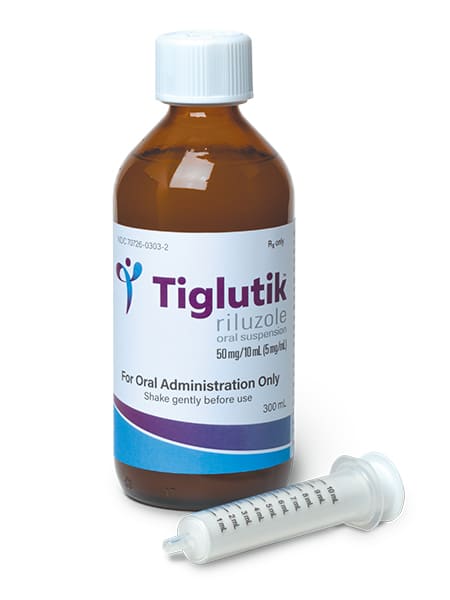
TIGLUTIK is the only formulation of riluzole approved by the FDA for both oral and PEG tube use1. One dose of oral suspension TIGLUTIK 50 mg (10 mL) is bioequivalent to one Rilutek® (riluzole) 50 mg tablet.1-3 Finally, people with ALS have a formulation of riluzole specifically designed to meet their needs, whether they have difficulty swallowing or have a PEG tube. TIGLUTIK can be used throughout all stages of ALS.2
Benefits of TIGLUTIK
Easy to swallow and lessens the risk of choking
Flows easily through feeding tubes and eliminates the risk of clogging
Mildly thick consistency designed to flow slower than thin liquids
Bioequivalent to Rilutek® (riluzole) 50 mg tablets
Reduces the need to stop treatment due to difficulties swallowing tablets or having a feed tube
Experts in pharmacology formulated TIGLUTIK to flow smoothly using advanced drug suspension technology. Based on the standards developed by the International Dysphagia Diet Standardization Initiative (IDDSI), TIGLUTIK has a mildly thick consistency (IDDSI criteria Level 2),3,4 and it is easy for patients to swallow or administer in a PEG tube.
Are Your Patients Crushing Their Tablets?
A study of 24 standard tablet crushing devices shows that, on average, 5.8% of the medication is lost during the crushing process.5 Eighteen out of the 24 tablet crushing devices evaluated had a statistically significant loss of drug. Patients who crush tablets may not receive the full indicated dose and get the expected benefit of treatment.
Data on file. EDW Pharma. Paoli, PA; December 2019.
International Dysphagia Diet Standardisation Initiative. https://iddsi.org/. Accessed July 1, 2020.
Thong MY, PLoS ONE 13(3): e0193683. https://doi.org/10.1371/ journal.pone.0193683
Expand
Indication
TIGLUTIK is indicated for the treatment of patients with amyotrophic lateral sclerosis (ALS).
Important Safety Information
Contraindication
TIGLUTIK is contraindicated in patients with a history of severe hypersensitivity reactions to riluzole or to any of its components.
Warnings and Precautions
TIGLUTIK can cause liver injury and there have been cases of drug-induced liver injury, some of which were fatal, in patients taking riluzole. Asymptomatic elevations of hepatic transaminases have been reported and, in some patients, have recurred upon re-challenge with riluzole. Maximum increases in ALT occurred within 3 months after starting riluzole. Monitor patients for hepatic injury every month for the first 3 months of treatment, and periodically thereafter; TIGLUTIK should be discontinued if there is evidence of liver dysfunction, for example, elevated bilirubin. Use of TIGLUTIK with other hepatotoxic drugs may increase the risk for hepatotoxicity.
TIGLUTIK can cause neutropenia. Cases of severe neutropenia (absolute neutrophil count less than 500 per mm3) within the first 2 months of riluzole treatment have been reported. Advise patients to report febrile illnesses.
TIGLUTIK can cause interstitial lung disease, including hypersensitivity pneumonitis. Discontinue TIGLUTIK immediately if interstitial lung disease develops.
Acute pancreatitis, including fatal and non-fatal necrotizing pancreatitis, has been observed in patients treated with riluzole in the postmarketing setting. Pancreatitis has occurred weeks to several years after initiation of riluzole.
Patients and caregivers should be warned that abdominal pain, nausea, vomiting, and/or anorexia can be symptoms of pancreatitis that require prompt medical evaluation. If pancreatitis is suspected promptly discontinue TIGLUTIK and initiate appropriate management. If an alternative cause is identified, reinitiation of TIGLUTIK may be considered.
Adverse Reactions
The most common adverse reactions (incidence greater than or equal to 5% and greater than placebo) of TIGLUTIK were oral hypoesthesia (29%), asthenia (19%), nausea (16%), decreased lung function (10%), hypertension (5%), and abdominal pain (5%).
Coadministration of TIGLUTIK with strong or moderate CYP1A2 inhibitors, such as ciprofloxacin, enoxacin, fluvoxamine, methoxsalen, mexiletine, oral contraceptives, thiabendazole, vemurafenib, and zileuton, may increase the risk of TIGLUTIK-associated adverse reactions.
Coadministration of TIGLUTIK with CYP1A2 inducers may result in decreased efficacy of TIGLUTIK.
Use in Specific Populations
Patients with mild or moderate hepatic impairment (Child-Pugh’s score A or B) had increases in AUC compared to patients with normal hepatic function. Thus, patients with mild or moderate hepatic impairment may be at increased risk of adverse reactions. Use of TIGLUTIK is not recommended in patients with baseline elevations of serum aminotransferases greater than 5 times the upper limit of normal or evidence of liver dysfunction.
Japanese patients are more likely to have higher riluzole concentrations, and thus may be at a greater risk of adverse reactions.